Braille for Music and Mathematics
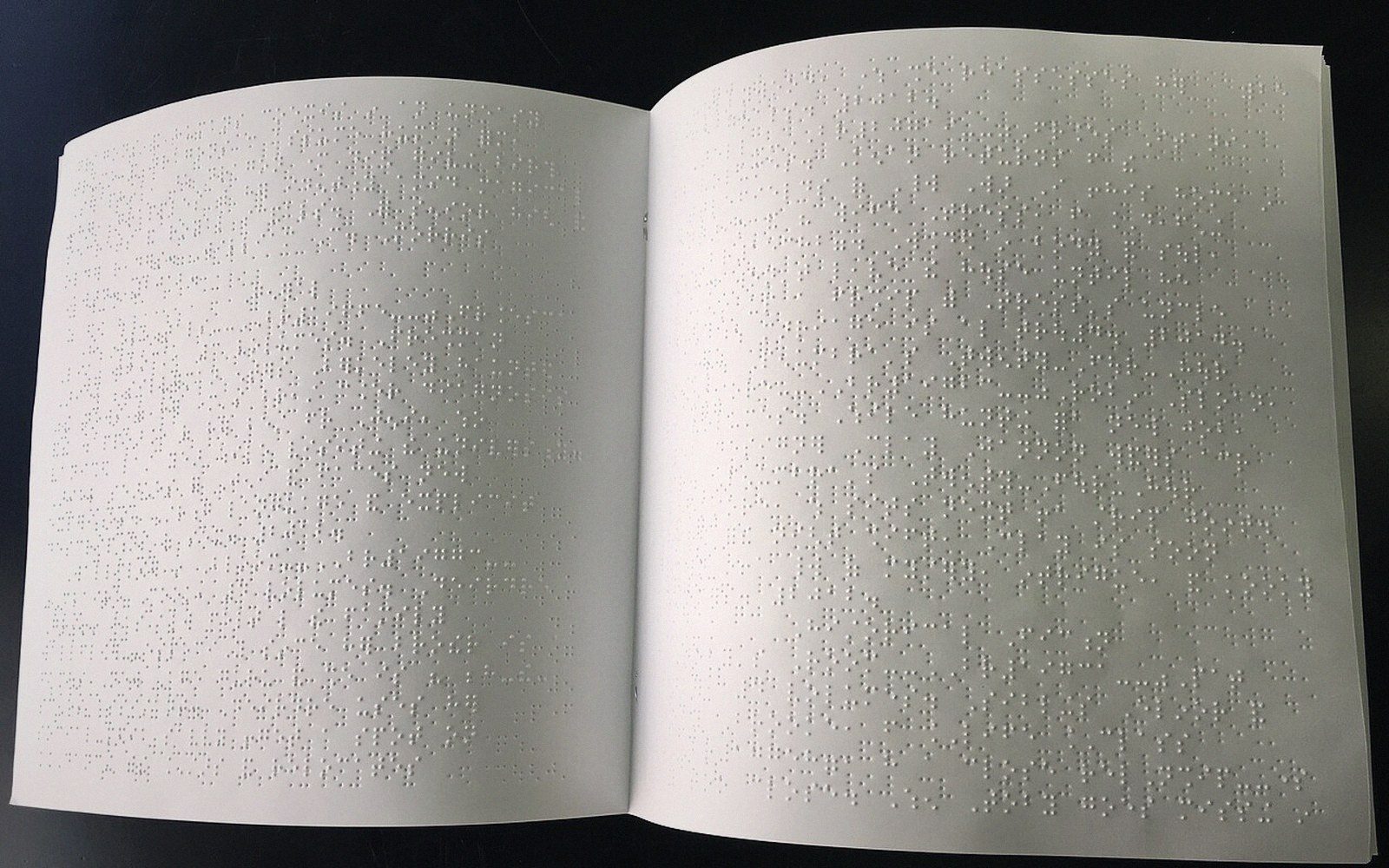
The six-dot braille cell was designed for language. Louis Braille finished his system in the 1820s with prose in mind — letters, punctuation, the flow of French sentences. What nobody quite anticipated was how far the same cell would have to stretch. Music notation and mathematical notation are both dense, structured, two-dimensional systems that print handles with spatial layout: staves climbing up a page, fractions sitting above and below a line, integrals nested inside brackets. Braille is linear. Fitting two entirely different kinds of non-verbal notation into 63 available combinations, without confusing them with each other or with literary text, required building two separate notational languages on top of the original alphabet.

01Two Systems, One Alphabet
Both exist. Both are in regular use. Both are genuinely difficult to learn and extraordinarily difficult to transcribe.
02Music Braille
Music braille was largely established by the mid-nineteenth century, with Louis Braille himself contributing foundational work — his 1829 publication included a method for music alongside the literary system. The current international standard, maintained by the World Blind Union, is called New International Manual of Braille Music Notation, though practitioners usually call it simply music braille.
The core principle is that a single cell carries several layers of meaning simultaneously. A cell that means the note C in one octave is modified by preceding cells that shift it up or down through the register. Duration — whole note, half note, quarter note — is encoded in the same cell as pitch, using the upper versus lower dot patterns. Rests, time signatures, key signatures, dynamics, fingering, articulation marks: each has its own assigned cell or cell sequence. The result is a notation system with several hundred distinct signs.

What makes music braille demanding is that it is entirely sequential. A printed score lets a musician see a full chord vertically — four notes stacked on a beat, grasped at a glance. In music braille, those four notes are read left to right, one after the other, then mentally reconstructed into simultaneity. A pianist reading a braille score must memorise a passage, both hands, before sitting at the keyboard; there is no glancing down at the page mid-phrase. This is not a deficiency of the system — it is simply what a linear medium requires, and skilled musicians work with it — but it explains why music braille transcription is among the most specialised work in the field.
03Mathematics Braille
Mathematical notation in braille has a more fractured history than music. Several competing systems developed across different countries and languages through the twentieth century. The Nemeth Code, created by Abraham Nemeth — himself a blind mathematician — was published in 1972 and remains the dominant system in North America. The UK uses a different standard, historically called Braille Mathematics Notation. In 2023, the Unified English Braille code incorporated a revised mathematics scheme, though Nemeth remains widely taught and used.
A maths textbook is widely considered the single hardest document type to transcribe into braille. Print mathematics is inherently two-dimensional: superscripts and subscripts, fractions with numerators above denominators, radicals with vinculum (the overbar of a square root), matrices arranged in rows and columns. In braille, all of this must be linearised. The Nemeth Code handles this through indicator cells — signals that tell the reader "what follows is a superscript," or "the fraction begins here," or "you are now inside a radical." Reading a complex expression means tracking several levels of nested indicators simultaneously, like parsing deeply embedded parentheses by memory.
How the cell does double duty
From the register| Item | What it means |
|---|---|
| Pitch + duration (music braille) | a single cell encodes both at once, upper dots for one dimension, lower for the other |
| Indicator cells (maths braille) | dedicated cells that function as brackets, signalling "what follows is a superscript / fraction / radical" |
| Context dependency | the same cell can mean different things in literary, music or mathematics braille; mode is set by surrounding signals |
The transcription burden is equally heavy. A transcriber working on a calculus textbook must render multi-line equations, aligned at the equals sign in print, into sequences of indicators and cells that a reader can parse linearly. A single display equation that occupies two print lines may require four or five braille lines, all of which must be logically coherent when read without any visual reference. Every spatial relationship in the original must be replaced by a sequential signal.
Both systems — music and mathematics — are proofs of the same uncomfortable fact: the six-dot cell is powerful, but it was never designed for this. That it works at all reflects decades of careful, unglamorous standardisation work, and the ongoing labour of transcribers who have learned not one specialist notation but two.
Both are genuinely difficult to learn and extraordinarily difficult to transcribe.
Chronology
From the register- 1829Louis Braille publishes music notation alongside his literary system
- 1972Abraham Nemeth publishes the Nemeth Code for mathematics in North America
- 2023Unified English Braille incorporates a revised mathematics scheme
More in Braille
Related entriesThis is an independent publication about accessible book formats. It is not a library, publisher or lending service, and it does not provide access to books or documents.