Proofreading by Touch
A braille proof cannot be checked with the eyes. Why the final stage of braille production belongs to a braille reader.

01The Eye Misses What the Finger Finds
A sighted proofreader looking at a braille page sees dots arranged on paper. They can verify that dots are present, that the page is not blank, perhaps that the embossing looks consistent. What they cannot do is read it. An incorrect contraction, a dropped cell, a grade-2 symbol standing in for the wrong word — none of these announce themselves visually. The error is structural, invisible to anyone who has not internalised the code.
This is why contracted braille requires a braille-literate proofer at the final stage. Grade 2 replaces common letter groups and whole words with single cells, and the substitution system is dense enough that a wrong cell can produce a different word entirely without altering the physical appearance of the page in any way a sighted eye would catch. The embossed dot either means something or it does not, and only a reader who knows what it is supposed to mean can tell the difference.
The check itself is tactile and linear. A proofer runs a finger along each line of the proof copy while following the source text — either in print, or as audio, or as a braille copy of the source — and flags every discrepancy. Pace is important: moving too fast risks sliding over a missing dot; moving too slow allows the tactile memory of one line to blur into the next. Experienced proofers develop a rhythm that is neither leisurely nor hurried, and they re-read any passage where the meaning felt uncertain on the first pass.
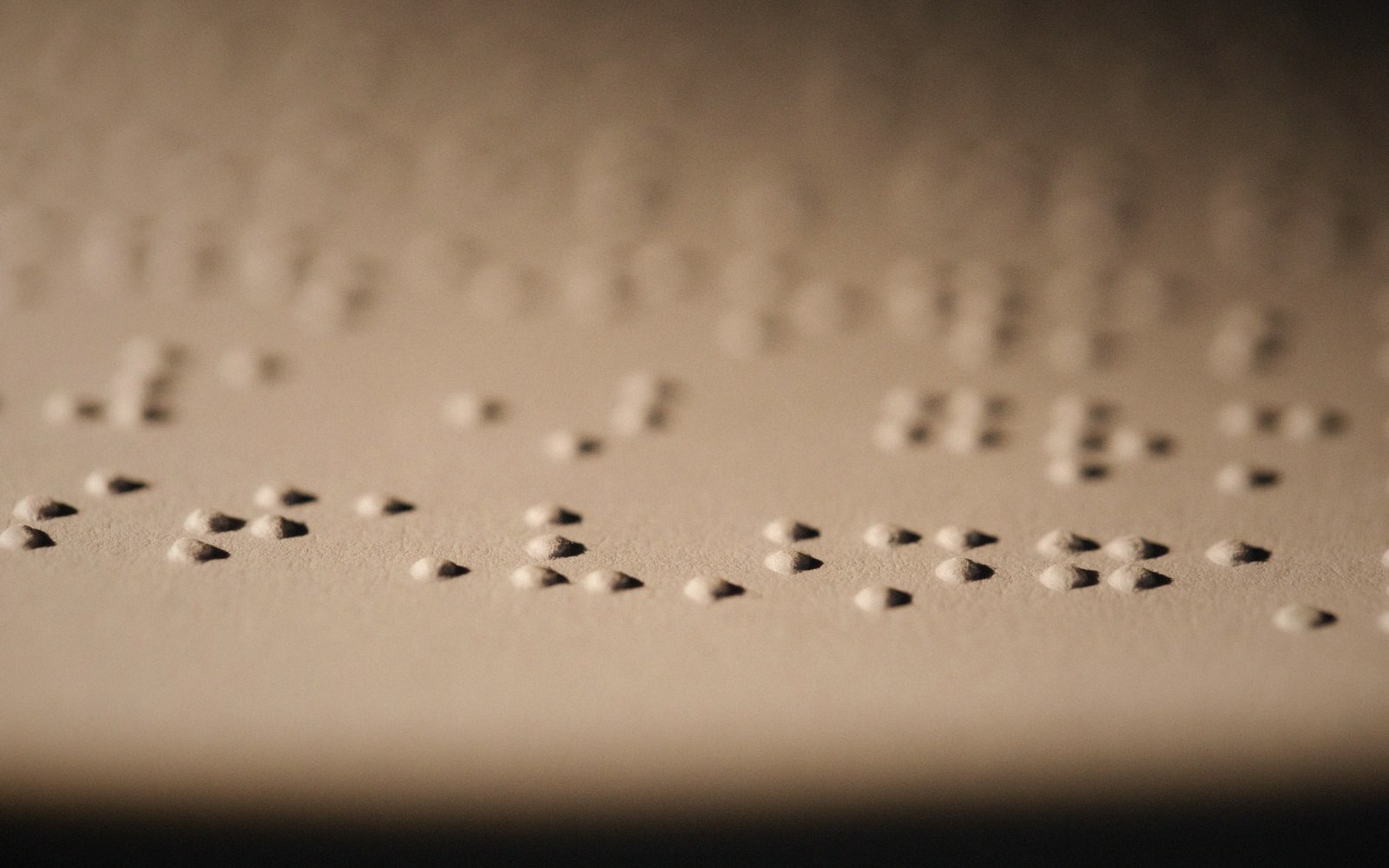
Errors that reach a finished embossed copy are expensive. The embossing process is not quick to reverse, and braille paper is heavy and costly. A clean proof protects the entire production run.
This is also why volunteer transcriber programmes train proofreaders as a distinct role from transcribers. Producing braille and verifying braille draw on the same literacy, but they are not the same skill, and most organisations treat them as separate qualifications.
How the check works
From the register| Item | What it means |
|---|---|
| Source material | what the proofer follows alongside the embossed copy: print, audio, or a separate braille source file |
| Tactile pass | finger moves line by line; pace is deliberate and consistent |
| Re-reading | any passage where meaning felt ambiguous on first pass is checked again |
| Flagging | errors are marked on the proof copy, not corrected in place; corrections go back to the transcriber |
An incorrect contraction, a dropped cell, a grade-2 symbol standing in for the wrong word — none of these announce themselves visually.
More in The Room
Related entriesThis is an independent publication about accessible book formats. It is not a library, publisher or lending service, and it does not provide access to books or documents.